
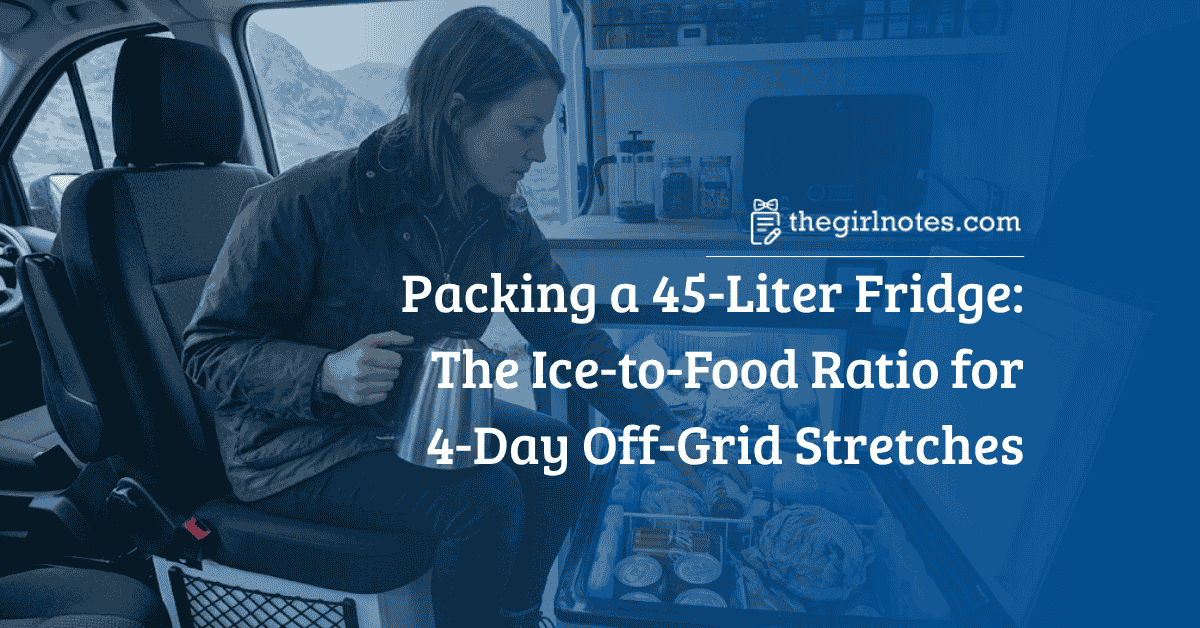
Packing a 45-Liter Fridge: The Ice-to-Food Ratio for 4-Day Off-Grid Stretches
A 45-liter compressor fridge is one of the most useful things in a camper kitchen and one of the most misused. People pack it like a home refrigerator, shove ice packs in the gaps, and wonder why everything in the back freezes while the front stays warm, or why the fridge is cycling constantly and pulling more battery than expected.
The packing strategy inside a 45-liter fridge determines temperature consistency, food longevity, and compressor run time. Those three things are connected, and the ice-to-food ratio is where the calculation starts.
Why 45 Liters Is Its Own Category
A 45-liter compressor fridge is not a scaled-down version of a home refrigerator. It is a different thermal environment that behaves by different rules.
Home refrigerators maintain temperature through a large internal volume with consistent airflow from a dedicated fan system. A 45-liter fridge maintains temperature through a small internal volume where the contents themselves act as thermal mass. What you put inside, how much of it there is, and how dense it is thermally all affect how hard the compressor works and how evenly the interior holds temperature.
A mostly empty 45-liter fridge is harder to keep cold than a well-packed one. Empty air space has low thermal mass and responds quickly to temperature changes every time the lid opens. A fridge packed with food and appropriate thermal mass holds its temperature through lid-open events and ambient heat fluctuations because the contents absorb and buffer those changes before they affect the compressor cycle.
This is why ice-to-food ratio matters. Ice and frozen items are not just there to keep food cold. They are thermal ballast that determines how stable the interior temperature stays across a 4-day stretch without shore power.
The Baseline Ratio for a 4-Day Off-Grid Stretch
For a 4-day off-grid stretch in moderate ambient temperatures between 65 and 85°F, the working ratio for a 45-liter compressor fridge is roughly 30% thermal mass to 70% food and drink by volume.
At 45 liters total interior capacity, that is approximately 13-14 liters of thermal mass and 31-32 liters of food and drink.
Thermal mass in this context means ice packs, frozen water bottles, or frozen food items that serve double duty as both food and cold source. It does not mean loose ice unless you are running a cooler rather than a compressor fridge. Loose ice in a compressor fridge introduces melt water management, accelerates corrosion on interior surfaces over time, and adds humidity that affects food quality. Frozen water bottles and reusable ice packs are cleaner solutions that deliver equivalent thermal mass without the melt management problem.
The 30% figure is a starting point, not a fixed rule. Ambient temperature, lid-open frequency, and the thermal conductivity of the fridge itself all shift the ratio. In high ambient heat above 90°F, increase thermal mass to 35-40% of interior volume. In cooler conditions below 60°F ambient, you can drop thermal mass to 20-25% and recover that space for food.
Where Temperature Actually Varies Inside a 45-Liter Fridge
Most 45-liter compressor fridges cool from the back wall or the bottom plate depending on the unit design. The coldest zone in the fridge is directly adjacent to the cooling surface. The warmest zone is near the lid, particularly toward the front where warm air enters during lid-open events.
This is not a flaw. It is a thermal gradient that exists in every small compressor fridge and the correct response is to pack according to it rather than ignore it.
Items that need to stay coldest go against the back wall or bottom plate. Raw meat, dairy, and anything with a short spoilage window at marginal temperatures goes in the cold zone. Items that tolerate moderate temperature variation go toward the front and top. Condiments, hard cheeses, cured meats, and drinks that are already sealed go in the warmer zones.
Thermal mass items, frozen water bottles and ice packs, go in the gaps between food items rather than consolidated in one corner. Spread thermal mass throughout the interior and it buffers temperature more evenly across the whole fridge. Consolidated in one area it creates a cold spot next to it and a warm spot everywhere else.
The most common packing mistake in a 45-liter fridge is treating it like a cooler and putting ice on top. Cold air falls. In a top-loading fridge that is partially correct logic. In a front-opening fridge, ice consolidated at the top does less thermal work than ice distributed through the middle and lower sections of the interior where the food actually sits.
Food Selection for a 4-Day Pack
The ratio only works if the food selection supports it. Packing a 45-liter fridge for 4 days with items that have inconsistent cold requirements forces compromises that no packing strategy fully solves.
A 4-day off-grid food plan for one to two people in a 45-liter fridge works best when it follows a consumption sequence. Items with the shortest shelf life at the fridge’s coldest reliable temperature get used on days one and two. Items with longer shelf life or lower cold sensitivity fill the remaining space and get used on days three and four.
Day one and two items: raw proteins, fresh leafy greens, soft cheeses, and anything with a use-by date inside the trip window. These go in the cold zone against the back wall.
Day three and four items: hard cheeses, eggs, cured meats, cooked grains stored in sealed containers, firm vegetables like carrots and cabbage that hold well at variable temperatures. These go in the front and middle sections.
Drinks are the biggest volume waster in a 45-liter fridge on a 4-day stretch. Four liters of beverages takes up roughly 9% of total interior capacity. If water is your primary drink and your van has a separate water system, keep only beverages that genuinely need refrigeration in the fridge. Everything else goes in a separate insulated bag or at ambient temperature.
The Compressor Cycle and Why Packing Affects Battery Draw
A compressor fridge does not run continuously. It cycles on when the interior temperature rises above the set point and off when it drops back down. The length and frequency of those cycles determines how much battery the fridge pulls across a 24-hour period.
A well-packed fridge with adequate thermal mass cycles less frequently because the thermal ballast absorbs ambient heat before it raises the interior temperature enough to trigger the compressor. A poorly packed fridge with low thermal mass and air gaps cycles more frequently because the interior temperature responds immediately to every heat input, lid opening, ambient temperature rise, and solar gain through the van body.
The practical difference in battery draw between a well-packed and a poorly packed 45-liter fridge in summer conditions is not trivial. A correctly packed Dometic CFX3 45 running in 80°F ambient draws approximately 0.8-1.2Ah per hour on average across a 24-hour period. The same fridge poorly packed with excess air space and inadequate thermal mass in the same conditions draws 1.6-2.0Ah per hour as the compressor works harder to recover temperature after every lid-open event.
Over a 4-day stretch that difference is 77Ah versus 154Ah of total battery consumption. On a 200Ah lithium bank that is the difference between arriving at day four with comfortable reserve and arriving nearly depleted.
Packing strategy is battery management. The two are not separate considerations.
Lid Discipline Over 4 Days
Thermal mass and packing ratio do the heavy work but lid discipline determines whether that work holds up across the full 4-day stretch.
Every time the fridge lid opens, warm air enters and cold air exits. The compressor responds to the temperature rise. In moderate ambient conditions a single lid-open event of 30 seconds raises interior temperature by 2-4°F and triggers a compressor cycle that runs for 3-5 minutes to recover. Five lid-open events per day adds roughly 15-25 minutes of additional compressor run time daily, which is not significant on its own but compounds across 4 days.
The habit worth building is knowing what you need before you open the lid. It sounds obvious and most people do not do it. Standing with the lid open while deciding what to make for lunch is the single most common source of unnecessary compressor cycling in a camper kitchen.
Organize the fridge so the most frequently accessed items, drinks, condiments, and snacks, sit at the front top section where they are reachable without moving other items. Deep-zone items that you access once daily go at the back. If pulling a back-zone item requires moving three things, you have the fridge organized for a stationary kitchen, not a mobile one.
Frozen Water Bottles vs Ice Packs: Which Thermal Mass Works Better
Both work. The practical differences are worth knowing before you decide which to use.
Frozen water bottles are free to produce if you have access to a freezer before departure. A 1-liter frozen water bottle provides approximately 80Wh of thermal energy as it transitions from frozen to liquid, which is equivalent to running a 10W load for 8 hours. As it melts it becomes drinking water, which recovers the space it occupied as thermal mass. The limitation is that melted water bottles sitting in a fridge add humidity and take up space you could use for food once they are no longer frozen.
Reusable ice packs stay solid longer than water bottles at equivalent size because most are filled with a gel or saline solution with a lower freezing point than water. They do not become a useful resource as they warm up the way water bottles do. They require freezer access to recharge between trips, which is a constraint if you are off-grid for extended periods without a shore power stop.
For a 4-day stretch the practical recommendation is a combination. Two or three reusable ice packs in the cold zone for sustained low-temperature performance, and two frozen water bottles toward the middle of the fridge that transition to drinking water by day three when their thermal work is done and the fridge contents have reduced enough to need less ballast anyway.
Realistic Temperature Expectations at Day Four
A correctly packed 45-liter compressor fridge running on a healthy battery bank in moderate ambient conditions will maintain 37-40°F through day four without shore power. That is the target range. Below 32°F and items near the cooling surface freeze. Above 40°F and the margin for raw proteins gets narrow.
The variables that push day-four temperature above that range are consistently high ambient heat above 90°F, a battery bank that has dropped below 12V and is no longer delivering full voltage to the compressor, a fridge positioned in direct sun or against a metal van wall that conducts heat, and a lid gasket that has degraded and no longer seals cleanly.
Check the lid gasket before every multi-day trip. Run a piece of paper around the closed lid seal. If it pulls out without resistance in any section, the gasket is not sealing and the fridge is working harder than it should across the entire trip. A replacement gasket for most 45-liter compressor fridges costs under $20 and takes ten minutes to install.
The Pack List That Works
For two people over 4 days in a 45-liter compressor fridge, this is the volume breakdown that hits the ratio and the consumption sequence correctly.
Thermal mass takes 13 liters: two 1-liter frozen water bottles and two standard reusable ice packs distributed through the interior, not consolidated.
Raw proteins for days one and two take 6 liters in sealed containers against the back wall cold zone.
Dairy, eggs, and soft items take 5 liters in the middle zone.
Hard cheeses, cured meats, and firm vegetables for days three and four take 8 liters in the front and upper sections.
Beverages that require refrigeration take 4 liters maximum at the front top for easy access.
That totals 36 liters against a 45-liter interior, leaving 9 liters of flex space for condiments, leftovers as the trip progresses, and the expanding space as thermal mass items are consumed or melt.
The flex space is intentional. A fridge packed to absolute capacity with no room for airflow around items creates cold spots and warm pockets that no ratio calculation fully corrects for. Leave the margin and let the thermal mass do the work.
