
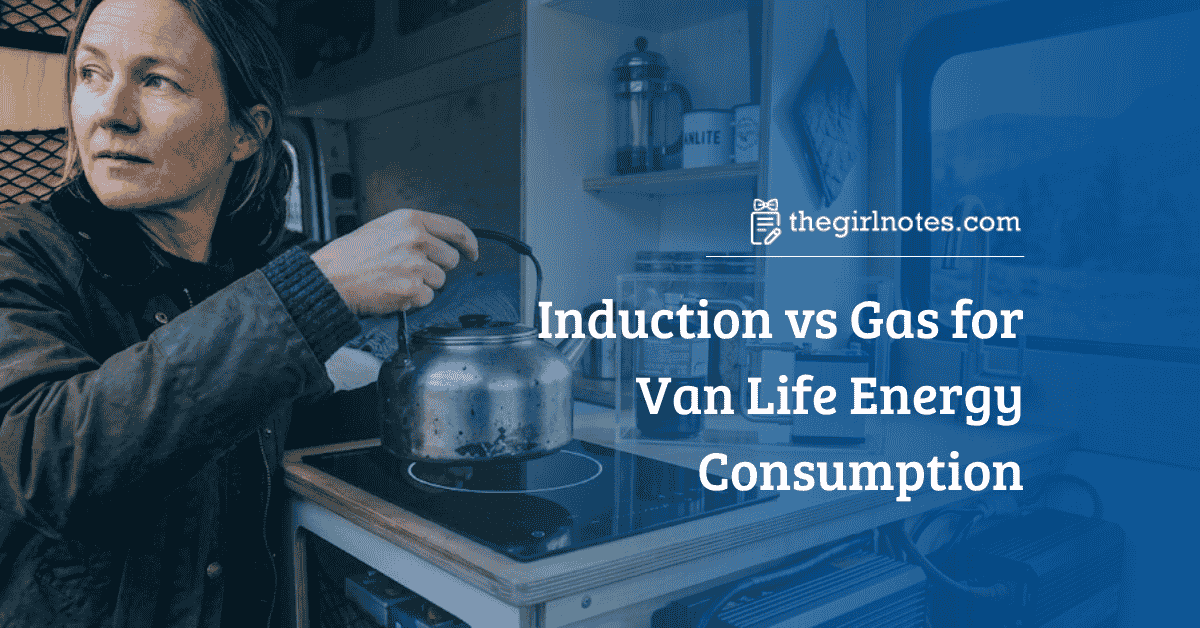
Induction vs Gas for Van Life Energy Consumption : Cooking Energy Breakdown
Why This Comparison Is More Complicated Than It Looks?
Induction versus gas for van life is not a straightforward efficiency comparison. The two systems store and deliver energy in completely different forms, replenish through different infrastructure, and interact with the rest of the van build in different ways.
Induction cooking uses electrical energy stored in a battery bank, converted to 120V AC through an inverter, then converted back to heat through electromagnetic induction in the pan. Each conversion step loses energy. The battery discharges, the inverter converts at 85-90% efficiency, and the induction element transfers heat to the pan at approximately 84-90% efficiency. The cumulative efficiency from battery to food is approximately 72-81% depending on inverter quality and cookware.
Propane cooking burns fuel directly at the burner and transfers heat to the pan through convection and radiation. A propane burner transfers approximately 40-55% of combustion energy to the pan under real cooking conditions. The rest escapes as ambient heat into the van interior. Propane is less thermally efficient than induction at the point of cooking but the energy source, the propane canister, stores far more energy per unit of weight and volume than any battery bank practical for a van build.
Comparing the two systems purely on thermal efficiency misses the point. The relevant comparison is total system cost, energy availability, and how each method interacts with a van’s electrical and ventilation setup across a realistic use pattern.
The Battery Math for Induction Cooking
A standard single-burner induction cooktop runs between 1200W and 1800W depending on the model and power setting. At 1500W through a 90% efficient pure sine wave inverter, the draw at the 12V battery bank is approximately 139 amps.
That number is worth sitting with for a moment. 139 amps is a substantial instantaneous draw on any van battery system. A 200Ah lithium battery bank delivering 139 amps is operating at a C/1.4 discharge rate, which is within lithium’s comfortable operating range but significantly higher than the typical background loads a van system handles.
A 20-minute cooking session at 1500W draws approximately 46Ah from the battery bank through the inverter. Two cooking sessions daily, breakfast and dinner, pulls 92Ah per day dedicated to cooking alone. On a 200Ah lithium bank at 80% usable capacity that is 57% of total daily usable capacity before accounting for refrigeration, lighting, phone charging, laptop use, water pump, and fan loads that run simultaneously.
The solar recharge requirement to offset daily induction cooking on a two-meal schedule is approximately 300-400W of panel capacity in summer conditions with reasonable sun exposure. In winter, at northern latitudes, or in extended overcast conditions the recharge rate drops below the daily cooking draw and the battery bank depletes over consecutive days without shore power intervention.
Induction as a primary cooking method is viable on a well-sized system. The minimum practical specification for daily induction cooking without shore power dependency is 200Ah lithium, 300W solar, and a pure sine wave inverter rated at 2000W continuous. Below those specifications induction cooking as a daily primary method creates chronic battery management stress.
The Propane Math for Van Life Cooking
A standard 1lb propane canister contains approximately 21,600 BTU of energy. A propane burner cooking two meals daily at moderate heat uses roughly 3,000-4,000 BTU per day for a one to two person van kitchen. That puts one 1lb canister at five to seven days of daily cooking use.
A 1lb canister costs $5-6 at retail. Daily cooking cost on disposable 1lb canisters runs approximately $0.85-1.20 per day. On a refillable 1lb adapter connected to a larger 20lb tank, the cost drops to approximately $0.08-0.12 per day of cooking at current propane prices. The cost difference between disposable and refillable propane infrastructure is significant over a full season of van life cooking.
The energy density comparison between propane and batteries is stark. A 1lb propane canister weighing 454 grams contains 21,600 BTU, which is equivalent to approximately 6.3 kWh of thermal energy. A 100Ah 12V lithium battery weighing approximately 12 kilograms stores 1.2 kWh of usable energy at 80% depth of discharge. To store the equivalent cooking energy of one 1lb propane canister in a lithium battery bank you need approximately 525Ah of lithium capacity weighing around 63 kilograms.
Propane wins the energy density comparison by a factor that makes battery-only cooking impractical for extended off-grid van life without very large solar and battery systems.
The Hidden Costs of Each System
Energy consumption numbers tell part of the story. The full comparison includes infrastructure cost, ongoing fuel cost, safety requirements, and the hidden costs that neither system’s advocates tend to lead with.
Induction hidden costs
A pure sine wave inverter capable of running a 1500W induction cooktop continuously costs $150-300 for a quality unit. A modified sine wave inverter will not run most induction cooktops reliably and is not a viable substitute. The inverter cost is a fixed infrastructure expense that propane does not require.
Battery bank upgrades to support daily induction cooking on a van that started with a single 100Ah AGM battery run $400-800 for a 200Ah lithium upgrade including battery management system. Solar panel additions to offset daily cooking draw run $200-400 for a second 200W panel with mounting hardware.
Total infrastructure upgrade cost to support induction as a primary cooking method on an underpowered starting system runs $750-1500 before buying the cooktop itself. On a system already specified for induction, the cooktop is the only additional cost at $40-80 for a reliable single-burner unit.
Propane hidden costs
A propane system in a van requires a regulator, supply hose, secure tank mounting, and a carbon monoxide detector rated for enclosed spaces. A basic single-burner propane setup with a 1lb canister adapter and a quality single-burner stove runs $60-120 in hardware. A permanently mounted system with a larger tank, through-hull fittings, and a dedicated propane locker runs $300-600 depending on tank size and installation quality.
Ongoing propane cost on a refillable system is low but propane requires access to refill infrastructure. In urban areas and established campgrounds propane refill stations are common. In remote areas and dispersed camping locations a 1lb canister adapter on a larger tank provides range that disposable canisters cannot match but the tank still eventually needs refilling.
Carbon monoxide management is a real ongoing cost for propane cooking in an enclosed van. A quality CO detector costs $30-50 and requires battery replacement or recharging. Ventilation during propane cooking requires either a roof vent fan running, which adds to electrical draw, or an open door or window, which affects temperature management in cold weather.
Real World Energy Consumption Side by Side
Removing the marketing language from both sides, here is what daily energy consumption actually looks like for a one to two person van kitchen cooking two meals daily.
Induction daily energy budget
Morning cook session 15 minutes at 1200W: 30Ah Evening cook session 20 minutes at 1500W: 50Ah Inverter standby draw during cooking sessions: 2Ah Total daily induction cooking draw: 82Ah
On a 200Ah lithium bank that is 41% of usable capacity before any other loads run. On a 300W solar system generating 80Ah on a good summer day, daily induction cooking alone consumes more solar generation than the panels produce. The system runs in deficit on cooking load alone without a second solar day of recovery between cooking days or shore power supplementation.
Propane daily energy budget
Two meals daily at moderate heat: 3,500 BTU average Weekly canister consumption at that rate: 0.6 of a 1lb canister Monthly propane cost on refillable system: $3-5 Electrical draw from propane cooking: zero from battery bank
The electrical draw difference is the clearest number in the comparison. Propane cooking pulls nothing from the battery bank. Every amp-hour saved on cooking is available for refrigeration, lighting, and device charging. On a modest 100Ah van electrical system, propane cooking is the difference between a system that manages daily loads comfortably and one that requires shore power every two to three days.
Which One Actually Makes Sense for Your Van
The answer depends on four variables specific to your build and travel pattern.
Battery bank size. Below 200Ah lithium, propane is the more practical primary cooking method and induction works as a supplemental option on shore power hookups. Above 200Ah lithium with adequate solar, induction becomes viable as a primary method with propane as backup.
Travel pattern. Full-time van dwellers who drive daily recharge the battery bank through the alternator and through solar simultaneously. The combined recharge from a driving day and a solar day often covers daily induction cooking draw. Weekend campers who park for three to four days without driving rely entirely on solar recharge, which makes induction cooking on a modest solar system a deficit situation from day two onward.
Camping environment. Fire-restricted areas and enclosed urban parking favor induction for safety and compliance reasons regardless of energy cost. Remote dispersed camping with limited propane refill access favors a larger propane tank over battery dependency for cooking.
Build stage. A van already equipped with a quality inverter, 200Ah or more of lithium, and 300W of solar can add induction cooking for the cost of a $50 cooktop. A van with a starter electrical system needs $750-1500 of upgrades before induction cooking is viable as a daily method. At that investment level a propane system covering the same cooking need costs $100-200 total.
Verdict
Induction is more thermally efficient at the point of cooking. Propane stores more energy per kilogram by a factor that makes battery-equivalent propane energy storage impractical for most van builds. The decision is not which method wastes less energy in the pan. It is which energy source fits the existing system, the travel pattern, and the budget for infrastructure.
For a well-specified van build with 200Ah lithium, 300W solar, and a pure sine wave inverter, induction as primary and propane as backup is a practical and functional setup. For a starter build or a weekend camping van, propane as primary with induction available on shore power hookups covers the cooking need at a fraction of the infrastructure cost.
Build the electrical system first. Then decide on the cooking method it can support.
Follow-up Questions
Can you run induction cooking entirely off solar without a battery bank? No. Solar panels do not produce consistent enough output to run an induction cooktop directly. Cloud cover, panel angle changes, and the gap between solar output and cooktop draw require battery buffering. A battery bank is not optional for solar-powered induction cooking. The solar panels charge the bank and the bank powers the cooktop.
Is a two-burner induction cooktop practical for van life daily cooking? A two-burner induction cooktop running both elements simultaneously draws 2400-3000W through the inverter. At 12V that is 220-278 amps instantaneous draw. Most van electrical systems are not wired for that load and most inverters sized for van builds cannot sustain it continuously. A single-burner induction cooktop is the practical specification for van life cooking. Sequential single-burner cooking covers the same meal preparation tasks with half the instantaneous draw.
