
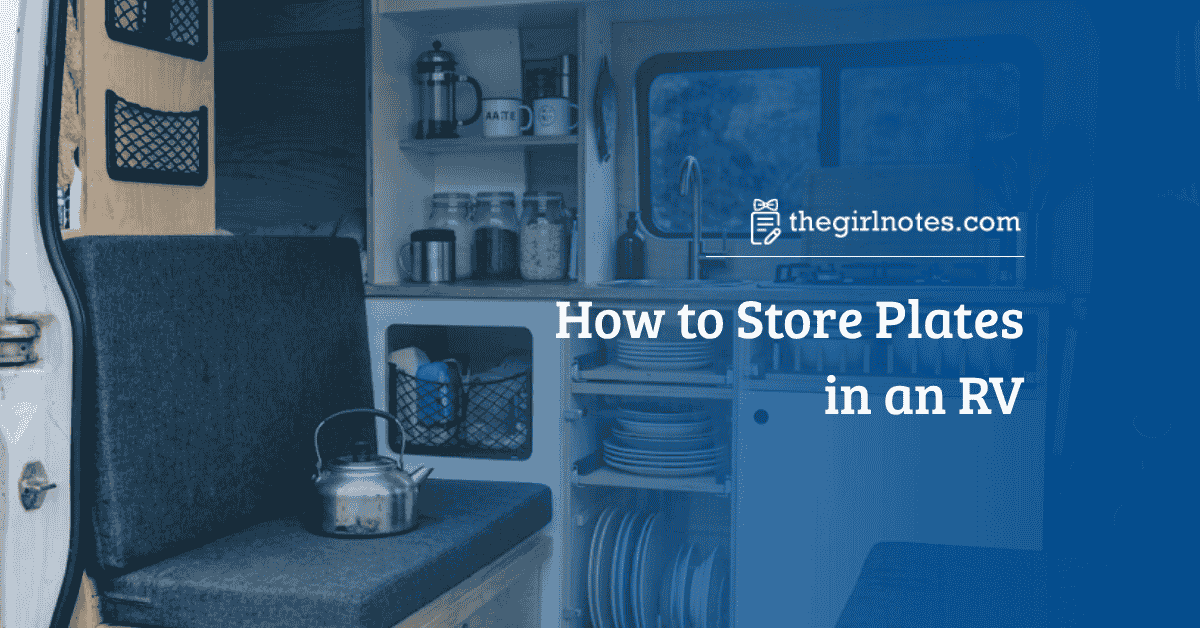
How to Store Plates in an RV: Keeping Them Secure, Accessible, and Unchipped
Stacking plates flat is the default storage method because it is how plates live in every stationary kitchen. In a moving vehicle flat stacking creates two problems that do not exist on a fixed shelf.
The first is edge chipping. Ceramic and stoneware plates stacked without separation contact each other at the glaze surface. Road vibration causes micro-movement between stacked plates continuously during driving. That micro-movement is not visible and not dramatic but it is constant and it abrades glaze at contact points over hundreds of miles. The chips that appear on plate edges after a season of RV travel are not from one hard bump. They are the accumulated result of continuous low-amplitude contact movement that flat stacking with no separation allows.
The second is stack migration. A flat-stacked plate stack in a cabinet shifts as a unit under lateral force. The bottom plate slides on the cabinet shelf. The stack leans into cabinet walls on corners. On hard braking the entire stack moves forward and the front plate contacts the cabinet door interior. Non-slip matting under the bottom plate addresses shelf migration but does not address the inter-plate movement that causes chipping.
Both problems are solved by separation material between every plate in the stack or by eliminating flat stacking entirely through vertical storage.
Separation Material Between Stacked Plates
If flat stacking is the only practical option given cabinet dimensions, the separation material between each plate determines whether the stack chips or not.
Felt is the most commonly recommended separation material for stacked plates and the performance gap between felt types is significant enough to matter in a mobile kitchen. Craft felt from a fabric store compresses to 30-40% of its resting thickness under plate weight. A 3mm piece of craft felt under a ceramic dinner plate compresses to approximately 1mm under load. At 1mm the plates are close enough that hard road vibration still produces contact movement at the edges.
Industrial felt at 0.3-0.5 grams per cubic centimeter density compresses to 60-70% of resting thickness under the same load. A 3mm piece of industrial felt stays at approximately 2mm under a stacked plate. That remaining thickness absorbs road vibration before it translates into plate contact. The difference between craft felt and industrial felt in a plate stack is the difference between a cabinet that produces a low rattle on dirt roads and one that is genuinely silent.
Silicone plate separators are the highest-performing option. They do not compress significantly under plate weight, conform to the plate surface at the edges where chipping occurs, and are washable. A set of silicone plate separators cut to the plate diameter costs $8-15 and outlasts multiple felt replacement cycles. For a permanent van or RV kitchen installation they are the correct choice over felt.
Cork sheet cut to plate diameter performs similarly to industrial felt at a lower cost. Cork at 3mm resting thickness compresses to approximately 2mm under ceramic plate weight and absorbs vibration effectively. It is less durable than silicone over repeated wet and dry cycles in a kitchen environment but is a practical alternative at a lower price point than purpose-cut silicone separators.
Vertical Plate Storage: The Better Solution for Most Cabinets
Vertical plate storage eliminates inter-plate contact entirely. Plates standing on their edges in individual slots do not touch each other regardless of road movement. There is no separation material to compress, no stack to migrate, and no edge chipping from continuous plate-to-plate vibration.
A vertical plate rack sized correctly for the plate diameter takes less cabinet depth than a flat stack of the same number of plates. Four ceramic dinner plates stacked flat with separators occupy approximately 3.5-4 inches of vertical cabinet height. The same four plates stored vertically in a rack occupy approximately 2.5 inches of cabinet depth and the full rack height of the cabinet, which in most RV lower cabinets is 10-14 inches.
The cabinet depth requirement for vertical storage is the plate diameter plus 1-2 inches of clearance for the rack frame. A 10-inch dinner plate requires a cabinet at least 12 inches deep for vertical storage. Most RV lower cabinets meet this requirement. Most RV upper cabinets do not, which is one reason vertical storage works better in lower cabinet installations.
Plate racks for vertical storage come in two relevant configurations for a camper kitchen. Fixed-slot racks hold each plate in an individual slot with a defined spacing. Expandable wire racks adjust slot spacing to fit different plate diameters. For a single plate size the fixed-slot rack is more stable under road movement because there are no moving parts. For a mixed plate collection the expandable rack accommodates the size variation but requires the slots to be tightened against the plate diameter to prevent rattling.
Cabinet Placement and Weight Distribution
Where plates live in an RV cabinet layout affects more than access convenience. Plates are among the heaviest items in a camper kitchen and their placement affects the vehicle’s center of gravity and handling characteristics.
Ceramic dinner plates weigh between 400 and 600 grams each. A set of four sits at 1.6 to 2.4 kilograms concentrated in whatever cabinet they occupy. In a van or small RV that weight is meaningful relative to total payload. In a larger Class A or Class C motorhome it is less significant but the placement principle still applies.
Heavy items belong in lower cabinets, positioned as close to the vehicle centerline as the kitchen layout allows. Plates in an overhead cabinet add weight above the center of gravity and increase body roll on corners. Plates in a lower cabinet below counter height keep weight low and central where it contributes to stability rather than reducing it.
The access argument for lower cabinet plate storage reinforces the weight argument. Plates retrieved from a lower cabinet require less reach and less risk of dropping than plates pulled from an overhead cabinet in a space where the ceiling is close and the floor is hard. A dropped plate from overhead cabinet height in an RV kitchen is a broken plate. A dropped plate from lower cabinet height has a better survival rate depending on floor material.
If the kitchen layout forces overhead plate storage, use lightweight materials. Melamine plates weigh 40-60% less than ceramic at equivalent diameter. Enamelware runs lighter than ceramic and survives drops on hard floors better than any ceramic or stoneware alternative. The material tradeoff for overhead storage is durability and weight, not cooking performance, and both melamine and enamelware perform adequately for the serving tasks plates are used for in a camper kitchen.
Plate Material and Storage Method Compatibility
Not every plate material suits every storage method. The combination of plate material and storage approach determines long-term chip and crack risk.
Ceramic and stoneware plates are the heaviest and most chip-prone. They require either industrial felt or silicone separation in flat stacks or vertical rack storage with individual slots. They are not suitable for loose storage in a cabinet without a rack or separation system regardless of how careful the packing is. Road vibration alone will chip unprotected ceramic against a cabinet wall or another plate over a season of driving.
Melamine plates are lightweight and chip-resistant but scratch easily. Vertical rack storage with plastic or rubber-coated slot dividers is the correct storage method. Metal wire rack slots in direct contact with melamine surfaces leave scratch marks at the contact points over repeated road vibration cycles. Coat bare metal rack slots with heat-shrink tubing or silicone dip coating before storing melamine plates in a wire rack.
Enamelware chips at the enamel coating rather than at the plate body. The underlying steel is undamaged by a chip but the exposed metal at a chip site rusts in a humid camper kitchen environment over time. Felt or silicone separation between enamelware plates in a flat stack prevents the enamel-to-enamel contact that causes chipping. Vertical storage is less critical for enamelware than for ceramic because the enamel coating is more impact-resistant than ceramic glaze, but separation material in a flat stack is still the correct approach for long-term condition.
Lightweight plastic camping plates are the only plate material that tolerates loose storage without separation in a deep cabinet. Their surface hardness is low enough that contact movement produces surface marks rather than chips, and their light weight means they do not generate enough momentum under road vibration to damage themselves or adjacent items. For a dedicated camping use case where weight and pack size are the primary constraints, plastic plates stored loosely in a stuff sack are a practical solution that no other plate material accommodates.
The Bungee Cord and Cabinet Latch Question
Plates stored correctly in a rack or with separation material still need the cabinet they live in to stay closed during driving. A cabinet latch that fails on a downhill braking event sends the entire plate storage system onto the kitchen floor regardless of how well the plates were organized inside the cabinet.
Factory RV cabinet latches vary significantly in quality between manufacturers and model years. The two-point magnetic catches used in many production RVs hold adequately on smooth roads and fail on rough ones because the magnetic force is calibrated for static load not dynamic impact. A cabinet door that opens under hard braking does so because the inertia of the contents briefly exceeds the magnetic catch force.
Positive latch systems that require a deliberate push-to-release action hold under dynamic load conditions that magnetic catches do not. Replacing factory magnetic catches with positive latches on any cabinet holding plates and heavy cookware is a one-time modification that prevents the most common cause of broken plates in a moving RV kitchen. The latch hardware costs $3-8 per cabinet and installs in under ten minutes with a screwdriver.
A secondary bungee cord looped through the cabinet handles as a backup retention system adds redundancy on rough road sections where even positive latches can be challenged by repeated hard impacts. The bungee is not a replacement for a functioning latch. It is a backup for the moments when the road is worse than expected.
Verdict
Plates stored flat without separation chip. Plates stored vertically in a correctly sized rack do not. The separation material between flat-stacked plates determines whether the cabinet is quiet or rattling on every dirt road. Industrial felt at 3mm or silicone separators cut to plate diameter are the correct materials. Craft felt is not.
Cabinet placement matters beyond convenience. Heavy ceramic plates belong in lower cabinets close to the vehicle centerline. Overhead plate storage works for lightweight materials only. Positive cabinet latches on any cabinet holding plates prevent the single most common cause of broken dishware in a moving RV kitchen.
A complete plate storage solution, vertical rack or flat stack with silicone separators, lower cabinet placement, and positive latch hardware, costs under $40 total and eliminates chipping, rattling, and breakage across a full season of varied road conditions.
FAQ
How many plates is realistic for a two-person van kitchen?
Four plates covers two place settings with two spares for guests or back-to-back meals without washing between. More than four in a van kitchen competes with cookware and food storage for cabinet space without adding practical utility for one to two person cooking. Four is the number most full-time van dwellers land on after a season of editing down from more.
Does plate diameter affect which storage method works better?
Yes. Plates above 10 inches in diameter require deeper cabinets for vertical storage than most van and small RV upper cabinets provide. In a kitchen with shallow upper cabinets, 10-inch plates or larger need flat stack storage with correct separation material. Switching to a 8 or 9-inch plate diameter opens vertical storage as an option in more cabinet configurations and reduces the weight per plate by 15-20% at equivalent ceramic thickness.
