
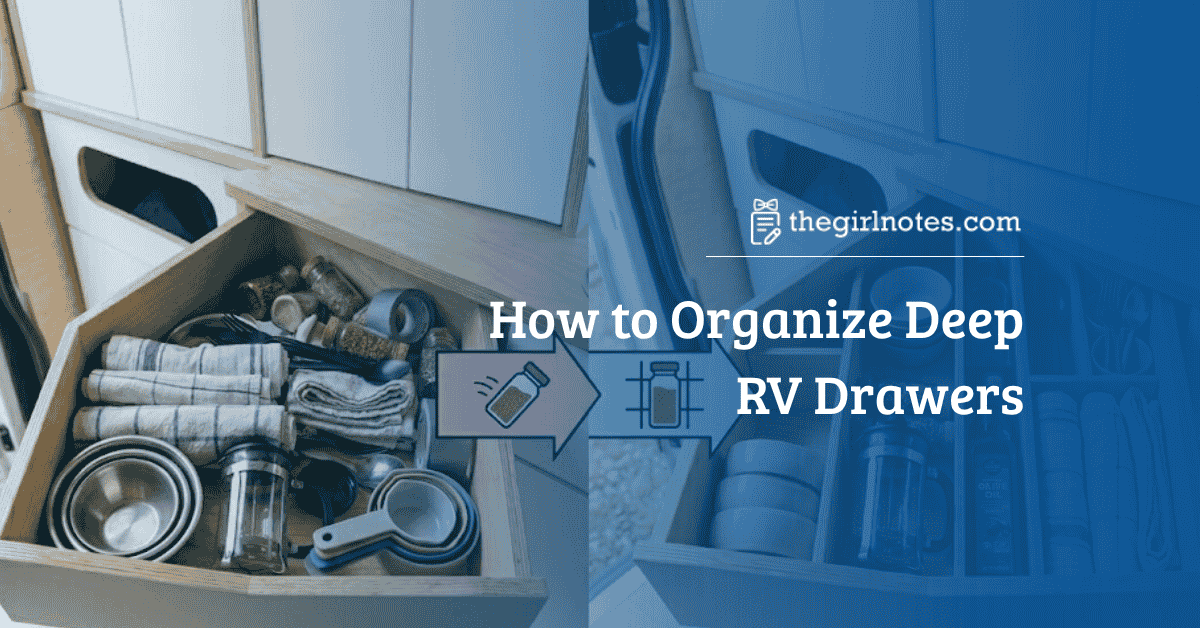
How to Organize Deep RV Drawers: Using Every Inch Without Losing Things at the Bottom
Why Deep RV Drawers Are Harder to Organize Than They Look?
A deep drawer in an RV or camper presents two problems that a shallow drawer does not. The first is vertical dead space. A drawer that is 6 inches deep holding items that are 2 inches tall wastes 4 inches of vertical space on every pull. The second is access layering. Items at the bottom get buried under items stacked on top and retrieving anything from the bottom layer means removing everything above it first.In a stationary kitchen both problems are annoying but manageable. In a moving vehicle they compound. Road vibration causes items to settle and shift downward, which means the bottom layer gets more compacted over time and the top layer migrates horizontally. A deep drawer that was organized on Monday looks like a jumble sale by Friday after three driving days.The organizing principle that solves both problems is vertical zoning. Instead of sorting items horizontally across the drawer floor, you divide the drawer into vertical zones that bring items to an accessible height regardless of drawer depth. Every item in a vertically zoned drawer is visible and reachable from the top without removing anything else first.
Drawer Dividers: The Starting Point
Drawer dividers address horizontal migration without solving the vertical depth problem. They are the correct first step and an incomplete solution on their own.A divider system in a deep RV drawer creates lanes that prevent items from sliding across the full drawer width during driving. Without dividers a deep drawer becomes a single large zone where everything migrates freely. With dividers it becomes several smaller zones where migration is contained within each lane.Tension-fit dividers that expand to press against both drawer walls are the best option for a camper or RV application. They require no adhesive, no screws, and no permanent modification. They reposition in seconds when the contents of the drawer change. Bamboo and plastic tension dividers both work. Bamboo is more rigid under sustained vibration and holds its position more reliably than lightweight plastic on rough roads.The divider height relative to drawer depth matters. A divider that is 2 inches tall in a 6-inch deep drawer only contains items up to 2 inches. Anything taller than the divider migrates over it under hard cornering. Match divider height to the tallest item in the drawer or use dividers in combination with a riser system that brings item bases up to divider height.Measure the drawer interior width before buying any divider system. RV drawer widths vary significantly between manufacturers and model years. Standard kitchen drawer organizers sized for residential cabinets frequently do not fit RV drawer widths, which run narrower in most builds. Measure first, buy second.
Riser Inserts: Solving the Depth Problem
A riser insert is a platform placed on the drawer floor that raises the item base height and reduces effective drawer depth. It is the solution to the vertical dead space problem that dividers alone cannot address.A riser that brings the drawer floor up by 3 inches in a 6-inch deep drawer effectively halves the depth and makes the bottom layer of items accessible without removing anything stacked on top. The space below the riser is not wasted. It stores flat items that do not need frequent access, spare batteries, folded cloths, instruction manuals, or anything retrieved once per trip rather than daily.Riser inserts for RV drawers do not need to be purpose-built products. A piece of 0.75-inch plywood cut to the drawer interior dimensions and lined with non-slip matting on both faces works as well as any commercial product. The non-slip lining on the bottom face prevents the riser from sliding in the drawer during driving. The non-slip lining on the top face prevents items on the riser from sliding during driving.For a drawer holding cooking utensils, a riser at half drawer depth brings spoons, spatulas, and tongs up to a height where they are visible and graspable from the top without searching. For a drawer holding food storage containers, a riser separates lid storage below from container storage above and eliminates the lid archaeology that makes deep drawers frustrating.Cut the riser from a single piece of material rather than assembling multiple pieces. A single piece sits flat, does not shift, and does not develop gaps at joints under vibration. If the drawer has a tapered interior, measure at the narrowest point and cut to that dimension so the riser drops in cleanly without binding.
Vertical Organizers for Specific Drawer Contents
The riser and divider system works for most drawer contents. Specific item categories have additional solutions worth knowing.Pots, pans, and lids are the hardest items to organize in a deep drawer because their size and weight make stacking impractical and their shape makes horizontal sorting inefficient. A vertical file organizer placed inside the drawer and lined with non-slip matting allows pots, pans, and lids to stand on their edges in individual slots rather than stacking flat. Each piece is accessible without removing anything else. The vertical file organizer takes the full drawer depth and converts it from a stacking problem into a filing problem. Expandable kitchen cabinet organizers designed for vertical pan storage work in deep RV drawers when cut or adjusted to fit the drawer interior width.Food storage containers and lids are the second most commonly disorganized drawer category in a camper kitchen. The problem is that containers and lids have different heights and nest differently depending on shape. A riser system with container bodies on top and lids stored vertically in a tension divider slot below solves the matching problem. Lids stored vertically in a slot are individually visible and retrievable. Lids stored flat in a stack require removing the top three to find the one at the bottom.Spice jars and small bottles migrate aggressively in deep drawers because their narrow base and high center of gravity make them tip easily under lateral force. A drawer organizer with individual cells sized to the jar diameter keeps each jar upright and individually accessible. Magnetic spice jar systems mounted to a cabinet wall are a better solution for frequently used spices, but for a complete spice collection in a dedicated drawer, individual cells prevent the tipping and migration problem more reliably than open divider lanes.Tools and hardware stored in a deep utility drawer settle to the bottom under vibration and create a dense, tangled layer that requires full drawer excavation to find anything specific. A two-level tray system with frequently used items on the upper tray and less frequently used items below solves the access problem. The upper tray lifts out as a single unit to reveal the lower layer. Modular tool tray systems designed for toolbox drawers fit most RV utility drawer widths and are built to handle the vibration conditions a moving vehicle produces.
Securing Drawer Contents for Driving
Organizing a drawer for stationary access and organizing it for driving are related but different problems. A drawer that is well organized at camp can become disorganized after a single rough driving day if the organization system does not account for road movement.The three forces acting on drawer contents during driving are lateral force from cornering, longitudinal force from braking and acceleration, and vertical force from road surface vibration. A complete drawer organization system addresses all three.Lateral force is addressed by dividers and tight-fit organizers that prevent horizontal migration across the drawer width. Any gap between the organizer and the drawer wall is space for items to migrate into. Fit organizers to the drawer interior with minimum clearance on all sides.Longitudinal force is addressed by the drawer latch itself and by packing the drawer to its organized capacity rather than leaving items loose in partially filled zones. A half-empty drawer zone allows items to travel the full length of the zone under braking. A zone filled to its organized capacity has no room for longitudinal travel.Vertical force from road vibration is addressed by non-slip matting on every horizontal surface in the drawer system and by selecting organizer materials that absorb rather than transmit vibration. Bamboo and wood organizers dampen vibration better than hard plastic. Silicone-lined organizers dampen it better than unlined wood. Hard plastic organizers on a hard drawer floor transmit road vibration directly to the contents and accelerate settling and migration compared to any lined alternative.
The Measurement Step Nobody Skips Twice
Every drawer organization system fails or succeeds at the measurement stage. An organizer that is 0.5 inches too wide for the drawer does not fit. An organizer that is 1 inch too narrow sits loose and migrates as a unit during driving. A riser cut 0.25 inches too long binds in the drawer and prevents it from closing fully.Measure every dimension before buying or cutting anything. Interior width at the front, middle, and back of the drawer separately because RV drawer interiors are frequently not perfectly parallel. Interior depth from front face to back wall. Interior height from floor to the underside of the drawer above.Write the measurements down and take them to the hardware store or use them to filter online organizer dimensions before ordering. The 15 minutes spent measuring correctly eliminates the return trip, the reorder, and the third attempt that most people make before landing on a system that actually fits.The drawer that gets measured once, organized once with the right materials, and lined with non-slip matting throughout is the drawer that stays organized for a full season of driving without requiring a reset after every rough road day.
Deep RV drawers are a vertical space problem disguised as a sorting problem. Sorting items horizontally does not fix a depth issue. A riser insert, tension dividers fitted to the drawer interior, and non-slip matting on every surface solves the actual problem. Specific contents like lids, spice jars, and pans have category-specific solutions that outperform general organizers for those items.
Verdict
Total cost for a complete deep drawer organization system using cut plywood risers, bamboo tension dividers, and silicone matting runs $15-25 per drawer. Purpose-built RV drawer organizers at camping retailers solve the same problem at two to three times the cost with less precise fit.
Follow-up Questions
Do drawer organization systems work in slide-out RV kitchens?
Yes with one addition. Slide-out drawers experience a lateral jolt when the slide-out retracts and extends. Items in a slide-out drawer need tighter-fit organizers with less clearance than fixed drawers to absorb that jolt without shifting. Non-slip matting is more critical in slide-out drawers than in fixed ones for the same reason.
How often does a deep drawer organization system need to be reset?
A correctly fitted system with non-slip matting and minimum clearance between organizers and drawer walls needs no reset between trips. A system with loose-fit organizers or no matting needs a reset after every two to three driving days on varied road surfaces. The difference is entirely in the fit and the matting, not in the organizer style or material.
