
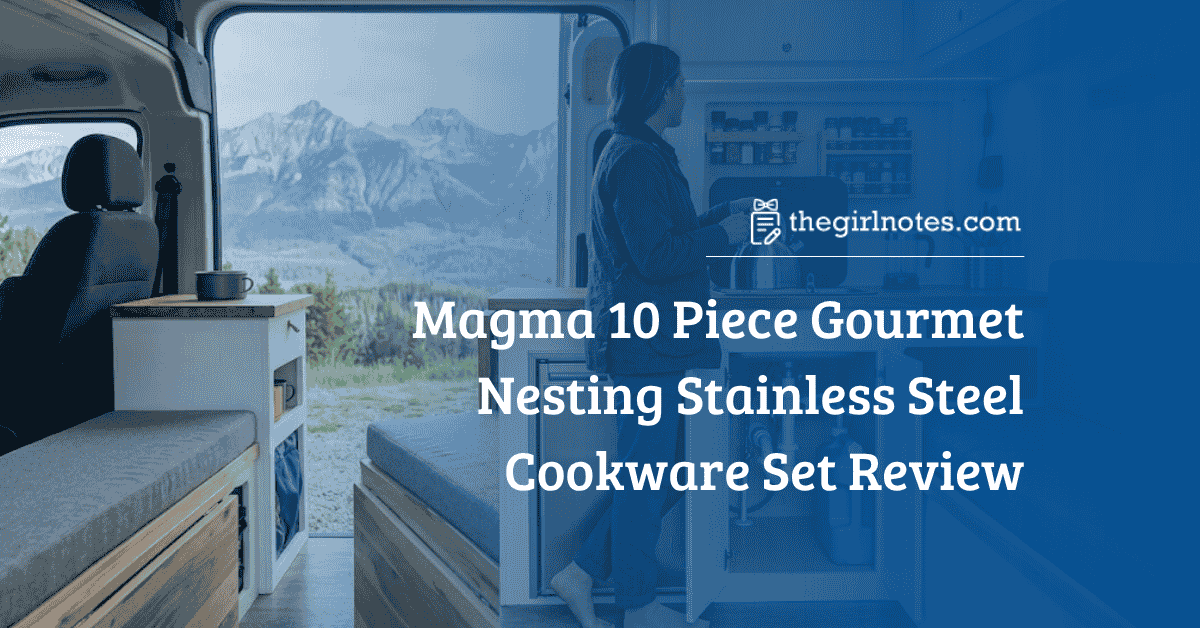
Magma 10 Piece Gourmet Nesting Stainless Steel Cookware Set Review
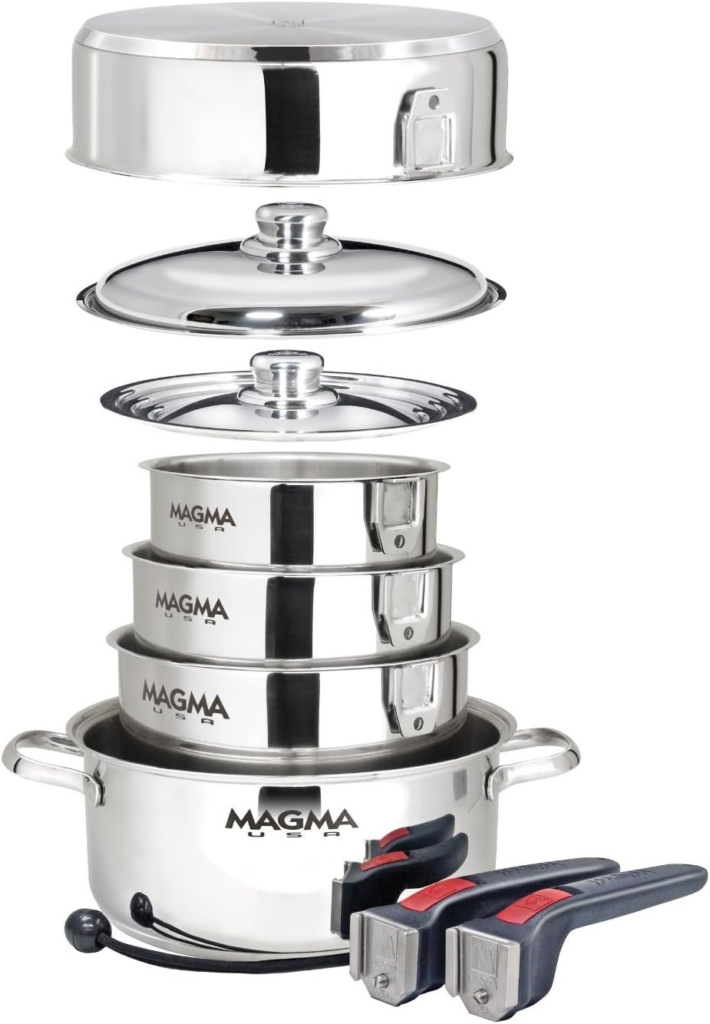
The Set for Magma A10-360L-IND What is in the box: 5 qt stock pot, 10-inch saute and frying pan, 3 qt sauce pan, 2 qt sauce pan, 1.5 qt sauce pan, one universal lid for all sauce pans, one lid for the stock pot and saute pan, two removable handles, one bungee storage cord
This sits in the under 500 bucks range for a 10-piece set, which puts it at the higher end of nesting cookware for camper and van kitchens. At that price point the question is not whether it is expensive. It is whether the engineering justifies the number. For a small mobile kitchen where storage space and induction compatibility both matter, the answer requires looking at what this set actually is and where it came from before landing on yes or no.
What the Set Actually Is
Magma started as a marine cookware company in 1976, building stainless steel products for sailboats where corrosion resistance and compact storage are non-negotiable. That origin matters because it explains why this set is engineered the way it is. It was not designed for a camper market and then rebranded. It was designed for a moving, space-limited kitchen environment from the beginning, and the RV and van life market found it rather than the other way around.
The set is built from 18-8 mirror-polished stainless steel with encapsulated tri-clad bottoms consisting of stainless steel, aluminum, and magnetic stainless steel layers milled flat for even heat distribution. The magnetic stainless steel outer layer is what makes it induction compatible. Cookware and lids are oven safe to 500°F excluding the removable handles, and the full set is dishwasher safe with the same handle exclusion.
The marine-grade stainless construction adds corrosion resistance that matters more in a van kitchen than most people account for. Condensation, humidity from cooking in an enclosed space, and water splashes in a compact sink area accelerate surface corrosion on lesser stainless steel over time. The marine spec is not marketing language here. It is a genuine material advantage in a mobile kitchen environment.
Storage: The Half Cubic Foot Claim
The entire 10-piece set nests and stores in less than half a cubic foot of cabinet space. That is the headline claim and it is accurate. The nesting system works because the handles detach completely, removing the part of cookware that normally prevents tight stacking. The thumb release trigger attaches and detaches with one hand and the mechanism is firm when engaged correctly.
In practice the nested set sits at approximately 10.25 inches in diameter and around 10 inches tall when fully stacked with the bungee cord securing everything together. That footprint fits in a standard lower cabinet in most van builds and RV kitchen configurations without modification.
After extended use the handle bracket can develop slight play. It does not affect cooking performance but changes the handle feel from solid to marginally loose. It is a known characteristic of the design rather than a manufacturing defect and it shows up in long-term use rather than straight out of the box.
The universal lid system is genuinely useful in a small kitchen. One lid fits the 1.5 qt, 2 qt, and 3 qt sauce pans. A second lid fits the stock pot and the saute pan. Two lids for five pieces of cookware is a meaningful reduction in cabinet space compared to a traditional matched set where every piece has a dedicated lid.
Induction Performance
The flat-milled tri-clad base is the critical detail for induction use. Induction requires consistent contact between the pan base and the cooktop surface for even heating. A warped or uneven base creates hot spots and cold spots that show up as inconsistent cooking results and can trigger the temperature protection circuit on some induction units.
The Magma base stays flat through repeated heating and cooling cycles. This is where the marine engineering background shows up most clearly in actual use. Cookware built for boat galleys has to handle rapid temperature changes without warping because the consequences in a moving vessel are more immediate than in a stationary kitchen. The same structural integrity applies in a van or camper context.
Heat distribution across the saute pan and sauce pans is even from edge to edge at medium induction settings. At high heat the outer inch of the pan heats slightly slower than the center, which is typical of clad-bottom rather than fully clad cookware. For most camper kitchen tasks, one-pot meals, boiling water, sauteing vegetables, heating proteins, this is not a practical limitation.
The 1.5 qt sauce pan is the piece that sees the most daily use in a small kitchen and it performs well at low and medium settings for sauces, reheating, and small-batch cooking. It runs slightly shallow for its rated volume, which means liquid reduces faster than expected if you are not watching it.
The Stainless Steel Learning Curve
Stainless steel without a non-stick coating requires technique that people coming from non-stick cookware do not always have. Food sticks to stainless when the pan is not hot enough before adding oil, or when protein is moved before it naturally releases from the surface. Both are technique issues rather than equipment failures, and they generate a significant portion of the negative reviews this set receives.
The set performs correctly when used correctly. Preheat on medium induction until a water droplet beads and rolls across the surface. Add fat. Add food. Do not move it until it releases on its own. That sequence works consistently across all pieces in the set.
The set also comes in a ceramica non-stick version. The bare stainless version lasts indefinitely with correct care. The non-stick version reduces the learning curve at the cost of a finite coating lifespan, which in a camper kitchen environment shortens faster than in a stationary home kitchen due to storage vibration, temperature variation, and more varied heat sources.
The Handle System in Daily Use
The removable handle design is the most discussed feature of this set and it earns that attention because it affects every cooking session, not just storage.
The trigger mechanism clicks onto a bracket welded to each piece. Engagement is positive and the handle stays put under normal cooking loads including a full 5 qt stock pot with water. The one-handed attachment works as described. You learn the motion quickly and after a week of daily cooking it becomes automatic.
The practical limitation is that you need the handle attached to move a hot pan and detached to nest the set for storage or transport. In a small camper kitchen where the pan goes from burner to a 14-inch counter, the handle removal step adds a beat to the workflow that a fixed-handle pan does not. It is not a serious friction point but it is a real one and worth knowing about before you commit to a handle-free cooking system for the first time.
One handle serves the entire set. The second handle included in the box is a spare and a genuine convenience. If you are cooking a two-pan meal, one handle moves between pieces as needed. Having two handles means you can keep both pans moving simultaneously without setting a hot handle down between transfers.
The handles are not oven safe. The cookware is rated to 500°F in the oven but the handles must come off before anything goes in. This is straightforward in practice and the detachment mechanism makes it a two-second step. It is worth knowing before you assume the whole assembly goes in oven-ready.
What the Set Does Not Include
At the $300-400 price point the set does not include a non-stick pan. Every piece is bare stainless steel in the standard version. For a camper kitchen where eggs are a daily protein and cooking fat management is tighter than in a house kitchen with unlimited counter space and time, the absence of a non-stick option in the base set is a gap worth planning around.
Magma sells a 10-inch non-stick omelette and saute pan separately that is designed to nest with this set. It adds to the total cost but it fits the storage system and solves the egg problem without introducing a mismatched pan that does not nest. If eggs are part of your regular rotation, budget for it as part of the initial purchase rather than as an afterthought.
The set also does not include a steamer insert or colander. Magma sells both as separate accessories sized to fit the 5 qt stock pot. Again, they nest with the set and fit the storage footprint. For a van kitchen where steaming vegetables or draining pasta without a full-size colander matters, the accessories are worth considering alongside the base set purchase.
How It Handles Van Life Conditions Specifically
The questions that matter for a camper kitchen are different from the questions a home cook asks about cookware. Corrosion resistance, storage footprint, induction compatibility, and durability under movement are the relevant variables. Performance on a gas range in a house kitchen is a secondary consideration.
On corrosion, the 18-8 marine-grade stainless holds up in humid van environments better than standard cookware stainless. Surface water dries without spotting in most conditions. The mirror polish makes water marks visible but they wipe off cleanly. After extended use in a van kitchen with limited drying space and occasional condensation exposure, the exterior finish stays intact without rust or pitting.
On storage under movement, the bungee cord system that secures the nested set is adequate for highway driving and moderate off-road conditions. On sustained rough roads the cord holds the stack together but the stack can shift as a unit in the cabinet. Adding a non-slip liner under the nested set in the cabinet prevents the shifting without requiring any modification to the set itself.
On weight, the full 10-piece set comes in at around 8 pounds nested. That is lighter than a comparable cast iron setup and heavier than a budget aluminum camping set. For a van where weight management matters on longer trips, the 8-pound figure is worth knowing. For most builds it is not a meaningful weight penalty.
The Lid Fit Issue
This comes up consistently in long-term user accounts and it is worth addressing directly.
The universal lid for the sauce pans fits all three sauce pan sizes. It fits the 3 qt well. On the 1.5 qt it sits slightly high because the diameter difference between the largest and smallest sauce pan in the set is large enough that a single lid cannot seal tightly on both ends of that range. The lid sits on the 1.5 qt rather than dropping into it, which means steam escapes around the edge during simmering.
For boiling and high-heat cooking this is not a practical issue because you are not relying on a tight lid seal. For low and slow simmering where the lid is doing thermal work, the fit on the smallest sauce pan is imprecise enough to require attention. Using the stock pot lid on the 1.5 qt produces a better seal than the universal sauce pan lid despite the size mismatch, which is a workaround that works but should not be necessary on a set at this price point.
Who This Set Is Right For
The Magma 10-piece induction set makes the most sense for a specific type of camper kitchen setup. Full-time or extended van dwellers who cook daily and need a complete set that stores in one compact footprint, runs on induction without compatibility issues, and holds up in a humid mobile environment over years of use. That is the use case this set was built for and it delivers on it.
It is less compelling for weekend campers who cook occasionally and do not need the full 10-piece range. A smaller nesting set or a two-pan propane setup covers occasional use at a fraction of the cost. The Magma set earns its price through daily use over time, not through a single camping weekend.
It is also less compelling for cooks who rely heavily on non-stick for everyday cooking and are not willing to learn stainless technique. The ceramica non-stick version addresses this but adds to an already premium price point and introduces the coating lifespan variable in an environment where cookware takes more abuse than in a stationary kitchen.
The Honest Summary
The Magma 10-piece induction nesting set does what it claims. It stores in a compact footprint, performs consistently on induction, handles the physical demands of a mobile kitchen, and is built from materials that last in humid and variable environments. The lid fit on the smallest sauce pan is a real limitation. The handle bracket play over time is a real characteristic. Neither is a dealbreaker but both belong in an honest account of the product.
At $300-400 it is the right purchase for a full-time van or camper kitchen being built to last. It is the wrong purchase for a kitchen that does not need all ten pieces or for a cook who is not ready to work with stainless steel.
