
RoadPro RPSL-350 12V Slow Cooker Review [What it Can and Cannot Do in a Camper Kitchen]
The RoadPro RPSL-350 sits in the budget range. At that span it is either a useful addition to a camper kitchen or a product that spends three trips in a cabinet before getting donated. Which one depends almost entirely on whether you understand what 96 watts at 12V can actually do before you plug it in.
The Electrical Reality First
96 watts at 12V draws 8 amps continuously. That is a manageable load for a camper or van electrical system. Run it for six hours and it pulls 48Ah from your battery bank. On a 100Ah lithium battery at 80% usable capacity that is 60% of your daily budget for one slow cook session.
The critical detail is that this unit is designed to run while driving. The alternator charges the battery simultaneously, which offsets the draw and makes the math work cleanly. Plug it in when you leave in the morning, arrive at camp in the evening, and dinner is ready. That is the use case the product was built for and it is a genuinely good one.
Running it stationary off a battery bank without solar or shore power recharge is a different calculation. Six hours at 8 amps on a parked van with no solar input is a real battery cost. On a well-sized system with 200Ah lithium and 300W of solar in reasonable conditions it is manageable. On a 100Ah AGM with a single 100W panel it will put you in deficit before dinner.
Know your system before committing to this as a daily cooking method.
What 150 Degrees Actually Means
The RoadPro heats to approximately 150°F and holds there. That is the single most important spec to understand about this product and the one the listing glosses over most.
A standard home slow cooker runs its low setting at 190-200°F and its high setting at 280-300°F. The RoadPro runs at 150°F and has no settings. One temperature, always on when plugged in.
150°F is above the safe minimum holding temperature for cooked food, which is 140°F. It keeps already-cooked food warm safely and it does cook raw food given enough time. But it cooks significantly slower than a home slow cooker on low, which means recipes written for a standard crock pot do not translate directly. A recipe that says four hours on low in a home slow cooker will need six to eight hours in the RoadPro to reach the same internal temperature in the food.
For a driving day that works. For a stationary cook session where you want food ready in four hours it does not.
What It Cooks Well
The sweet spot is low-moisture, long-cook food. Dried beans soaked overnight, lentil soups, hearty vegetable stews, and tough cuts of meat that benefit from extended low heat all perform well given adequate time. The low temperature is actually an advantage for these foods because it is nearly impossible to overcook them even on a long drive day.
Chicken thighs with liquid cook through safely in six to seven hours. Chicken breast is less forgiving because the lower fat content dries it out at extended cook times even at low temperature. Stick to thighs and legs for poultry. Oats cooked for six to eight hours overnight produce a soft porridge-style result that works well for a camp breakfast without any morning effort.
What it does not cook well is anything requiring above 150°F for texture or food safety at shorter cook times. Rice without excess liquid turns gummy. Pasta absorbs all the liquid and becomes paste. Anything requiring a simmer or boil is outside what this unit delivers regardless of cook time.
The Crock and Lid
The removable stoneware crock is the best part of this product. It lifts out cleanly, is dishwasher safe, and holds 1.5 quarts which is enough for one generous serving or two moderate ones. In a van kitchen where washing up is already a water management exercise, a crock that can be rinsed easily in a small sink or run through a campground laundry facility dishwasher is a real convenience.
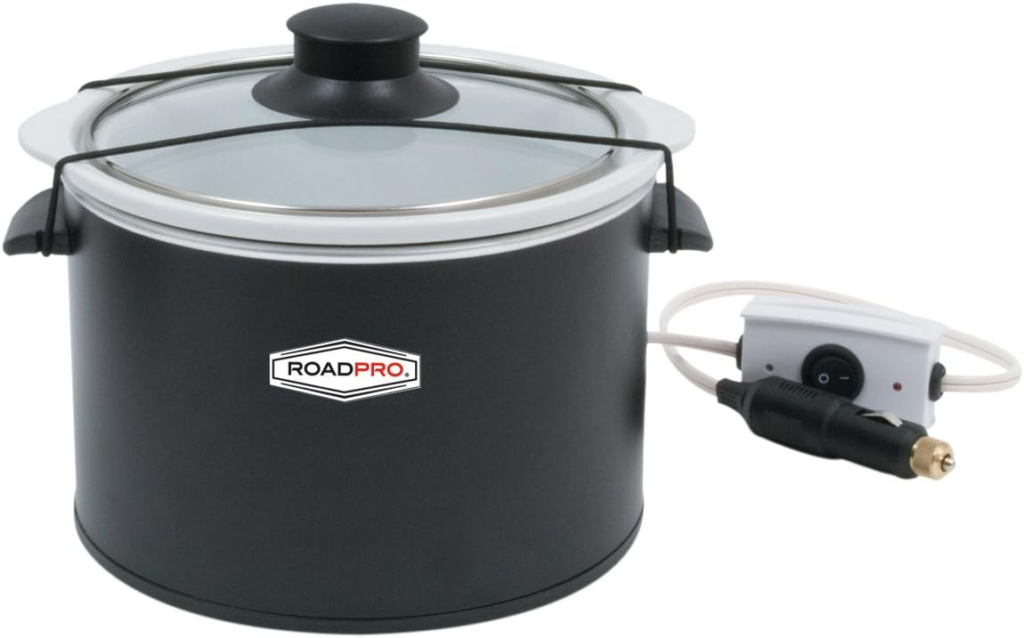
The glass lid sits on top of the crock and is secured during travel with a stretch cord that hooks onto the base handles. The stretch cord is not a tight seal. It keeps the lid from lifting off during highway driving but it does not prevent liquid from sloshing if the unit tips on a rough road. Position it on a flat surface and the cord is adequate. Mount it at any angle and you will have liquid on the van floor.
Steam escapes around the lid edges during cooking which is normal for a slow cooker but means you need slightly more liquid than a standard recipe calls for. Add 10-15% more liquid than a home slow cooker recipe specifies and the results are consistent.
Physical Design in a Camper Context
The unit sits at 8.9 x 8.8 inches at the base and 7.3 inches tall. It fits on a standard van counter with room to spare. The 6-foot power cord reaches a 12V socket from most counter positions without stretching. The inline on/off switch on the cord is a practical feature because it lets you cut power without unplugging from the socket, which matters when the socket is in an awkward location behind a seat or under a cabinet.
The stoneware crock holds heat long after the unit is unplugged, which means it doubles as a passive warmer on rest stops without drawing any power. Unplug it 30 minutes before you stop and the food stays at serving temperature for another 45-60 minutes inside the insulated base. That is a useful characteristic on a drive day where you want to stop and eat without reheating anything.
The stretch cord lid retention is functional on paved roads and unreliable on rough ones. If your camping involves significant off-road driving the lid will lift under hard bumps and splash the contents. A secondary silicone band or a small bungee over the top solves this and costs nothing.
Who This Is Actually For
The RoadPro RPSL-350 is a driving-day cooker. It is at its best when plugged into a vehicle running its alternator for six to eight hours. The alternator offsets the battery draw, the long drive provides the cook time the low wattage requires, and you arrive at camp with a meal ready without having touched a burner all day.
It is a poor choice for a stationary cook setup where you need food ready in under four hours, for anything that requires boiling temperature, or for a system without adequate battery capacity to handle a 48Ah daily cook load without solar or alternator input.
For full-time van dwellers and long-haul campers who drive regularly and want a hands-off cooking option that does not require monitoring a burner while moving, it earns its counter space and its price point. For weekend campers who park and cook stationary, the limitations outweigh the convenience and a small propane setup serves the same kitchen better.
The product does exactly what its specs describe. The gap between buyer expectation and product reality is not an engineering problem. It is a listing problem. Read the wattage, understand the temperature ceiling, and match it to your actual driving and cooking pattern before buying.
